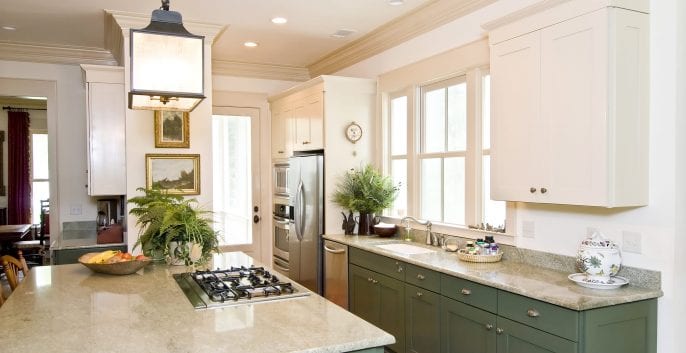
When a South Florida kitchen starts to feel dated, most homeowners assume the only fix is tearing out the cabinets and starting over. That is rarely the case. In a lot of homes, the cabinet boxes are still solid, and what looks tired is really just the finish. Before you commit to a full replacement, it helps to understand what each path actually involves, because the difference in cost, time, and disruption is usually larger than people expect.
The two honest options
Refinishing, sometimes called cabinet repainting, keeps your existing boxes, doors, and drawers and gives them a fresh, durable finish. Replacing means removing everything down to the wall and installing brand new cabinetry. For most kitchens the real decision comes down to refinishing versus full replacement.
The right answer depends less on what your kitchen looks like and more on the condition of what is underneath.
Cost, time, and disruption at a glance
| Factor | Refinishing | Replacing |
|---|---|---|
| Relative cost | A fraction of new cabinetry | The highest cost of the two by a wide margin |
| Timeline | Usually a matter of days | Often weeks, with lead time on the cabinets themselves |
| Disruption | Kitchen stays largely intact and usable | Counters, plumbing, and sometimes flooring come out |
| Layout changes | None, same footprint | Full freedom to redesign |
| Best when | Boxes are sound, you want a new look | Boxes are failing or the layout is wrong |
Notice that the only column where replacement clearly wins is layout. If your kitchen flows well and you simply want it to look current, refinishing tends to deliver most of the visual payoff for a much smaller share of the budget and the headache.
When refinishing makes sense
Refinishing is the smart move more often than people think. It is a strong fit when:
- The cabinet boxes are structurally sound and the doors close properly.
- You like your current layout and storage and are not chasing a different floor plan.
- The wood is solid or quality plywood rather than swollen particleboard.
- Your main goal is color, sheen, and a clean, modern feel.
- You want the kitchen back in service quickly and with minimal mess.
A well done refinish also protects what you already own. In South Florida humidity, once a finish starts to chip the coating breaks down and the exposed wood becomes vulnerable to moisture, warping, and rot. A fresh finish seals those surfaces again and stops that decay before it spreads. You can read more about how that work is done on our cabinet refinishing page.
When replacement is the better call
Sometimes new cabinetry is genuinely the right investment, and we will tell you so. Replacement earns its higher cost when:
- The boxes are sagging, water damaged, or made of particleboard that is already swelling.
- You want to change the layout, add an island, or reconfigure how the kitchen functions.
- Doors and drawer fronts are broken beyond simple repair.
- You are remodeling the whole room and the cabinets are part of a larger plan.
No finish can fix a failing box. If the structure is gone, paint only hides the problem for a while.
Does a refinish actually last?
This is the question we hear most, and it comes down to two things: the surface underneath and the work that goes into prep. A factory finish on new cabinets is durable because it is applied to clean material in controlled conditions. A professional refinish gets close to that result by doing the unglamorous work first, which means thorough cleaning to cut years of grease, careful sanding for adhesion, and proper priming before any color goes on. Skip those steps and the finish peels within a year. Do them right and a refinished kitchen holds up to daily use for a long time.
A word on finishes
One advantage of refinishing is choice. Cabinets can be stained to bring out the wood grain or painted to open up nearly any color. Sheen matters too. Matte hides small imperfections but is harder to keep clean, satin gives an easy to wipe middle ground, and semi-gloss stands up best to moisture and the constant handling that cabinets get every day. We walk through these trade-offs with you during the estimate so the result fits how you actually live in the kitchen. The same care applies across our wider interior painting work.
How to decide
Start with the boxes, not the look. If the structure is sound and you are happy with the layout, refinishing almost always gives you the better return. If the cabinets are failing or you want a different kitchen entirely, replacement is the honest answer. The look you want is achievable either way, so let the condition and your plans guide the choice rather than the surface appearance alone.
The simplest rule of thumb: fix the finish when the bones are good, replace when the bones are gone.
Vivid Coat is locally owned and works with homeowners across South Miami and South Florida, so we can look at your actual cabinets and give you a straight recommendation, not a sales pitch. You can see the full range of what we do on our services page. When you are ready, contact us for a free estimate and we will help you decide whether to refresh what you have or invest in new.